Understanding Flood Zones AE, VE, and the LiMWA Line If you are planning to build, renovate, or purchase property near the coast, you have likely encountered a confusing alphabet soup of acronyms: AE, VE, BFE, and LiMWA.
Today, we are breaking down the critical designations and elevation metrics you need to understand before breaking ground.
The Crucial Math of Coastal Building: BFE, Freeboard, and DFE
Before diving into the specific flood zones, it is essential to understand three interconnected terms that dictate exactly how high your home needs to be built to stay dry and compliant: BFE, Freeboard, and DFE.
- Base Flood Elevation (BFE): This is the regulatory baseline. Established by FEMA, the BFE is the exact elevation that floodwaters are statistically expected to reach during a 1% annual chance flood (often called the “100-year flood”). A very common misconception among property owners is that a BFE of 9 feet means you must build 9 feet above the ground (grade). This is incorrect. All BFE requirements are measured from sea level (specifically, a standard called NAVD88). For example, if your lot already sits at a natural ground elevation of 5 feet above sea level, and your BFE is 9 feet, you have 4 feet of potential floodwater to engineer around. You don’t need to build 9 feet off the ground; you need to go 4 feet up to reach that 9-foot BFE mark.
- Freeboard: Think of freeboard as your built-in safety buffer. It is an additional height requirement—typically 1 to 3 feet—added on top of the BFE. Many coastal municipalities mandate a specific amount of freeboard in their local building codes. Even if it isn’t required, building with freeboard is highly recommended. Not only does it provide crucial extra protection against rising sea levels and extreme storms, but adding freeboard can significantly reduce your annual flood insurance premiums.
- Design Flood Elevation (DFE): This is the final, ultimate number your architect and builder care about most. The DFE is simply the BFE plus your Freeboard (BFE + Freeboard = DFE). If FEMA dictates a BFE of 9 feet, and your local building department requires 2 feet of freeboard, your DFE is 11 feet (again, measured from sea level). The lowest required structural element of your home must be elevated to or above this final DFE line.
1. Flood Zone AE: The Standard High-Risk Area
What it is: Zone AE is a high-risk flood hazard area. Properties in this zone have a 1% annual chance of flooding. In Zone AE, FEMA provides a Base Flood Elevation (BFE) to guide construction.
What it means for building: While Zone AE is high-risk, it is generally considered an area subject to “stillwater” flooding or low-velocity wave action (waves less than 1.5 feet high).
- Elevation: The lowest floor of your home must be elevated to or above the DFE (the BFE plus your local freeboard requirement).
- Foundations: Homes here are typically built on elevated foundation walls, crawlspaces, or fill dirt.
- Venting: If you have an enclosed space below the DFE (like a crawlspace or garage), it must have engineered flood vents to allow water to flow freely in and out, preventing hydrostatic pressure from collapsing the walls.
2. Flood Zone VE: The Coastal High Hazard Area
What it is: Zone VE is also a high-risk area with a 1% annual chance of flooding, but with a massive added danger: velocity wave action. These zones are located directly on the coastline and are expected to be hit by storm-driven waves that are 3 feet or higher.
What it means for building: Because the destructive force of 3-foot waves is catastrophic to standard walls, the building codes in Zone VE are incredibly strict.
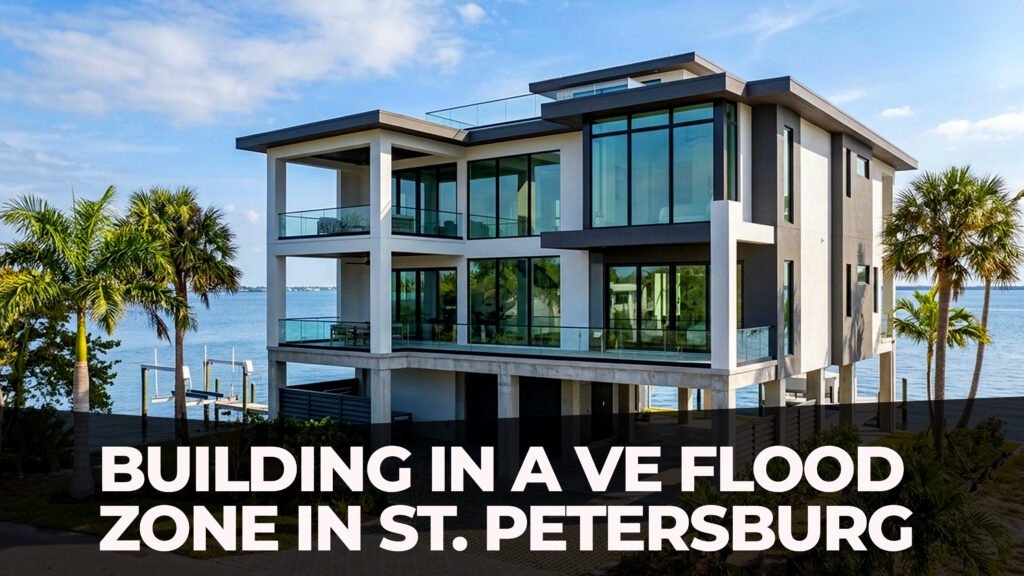
- Foundations: You cannot use solid foundation walls or fill dirt. Homes must be built on open foundations, primarily deep-driven timber, concrete, or steel pilings.
- Elevation: The bottom of the lowest horizontal structural member (the floor joist) must be elevated above the DFE, not just the finished floor.
- Enclosures: Any enclosed space below the DFE is strictly limited in size and must be constructed with breakaway walls. These walls are designed to shatter and wash away when hit by waves, preventing the wave force from pulling down the entire house.
3. The LiMWA Line: The Hidden Transitional Zone
What it is: LiMWA stands for Limit of Moderate Wave Action. It is a line drawn on FEMA flood maps that sits inside Zone AE. It marks the inland limit of the area expected to be hit by waves between 1.5 and 3 feet high during a major flood.
What it means for building: Historically, FEMA treated everything landward of Zone VE as a standard AE zone. However, engineers realized that waves between 1.5 and 3 feet (now called the “Coastal A Zone”) carry enough hydrodynamic force to destroy standard AE-zone foundation walls.
- The Coastal A Zone: The area between the VE zone and the LiMWA line.
- Building Codes: Many local municipalities and modern building codes (like the IBC/IRC) now require homes built in the Coastal A Zone (seaward of the LiMWA line) to meet Zone VE standards.
- Best Practices: Even if your local municipality hasn’t adopted the stricter codes yet, building to Zone VE standards (using pilings and breakaway walls) in a LiMWA area is highly recommended. Relying on standard solid foundation walls in an area prone to 2-foot crashing waves is a recipe for structural failure.
The Bottom Line for Your Build
Understanding the difference between AE, VE, and LiMWA isn’t just about getting a building permit; it dictates the entire architectural and structural design of your home. A line drawn on a map determines whether you are pouring standard footings or driving 30-foot wooden pilings into the sand.
At KHBuild.PRO, we specialize in turning these complex coastal regulations into safe, stunning, and resilient custom homes. If you are looking at a coastal lot and trying to decode the flood map, contact us today. We can help you understand the terrain, the requirements, and the best path forward for your dream build.